
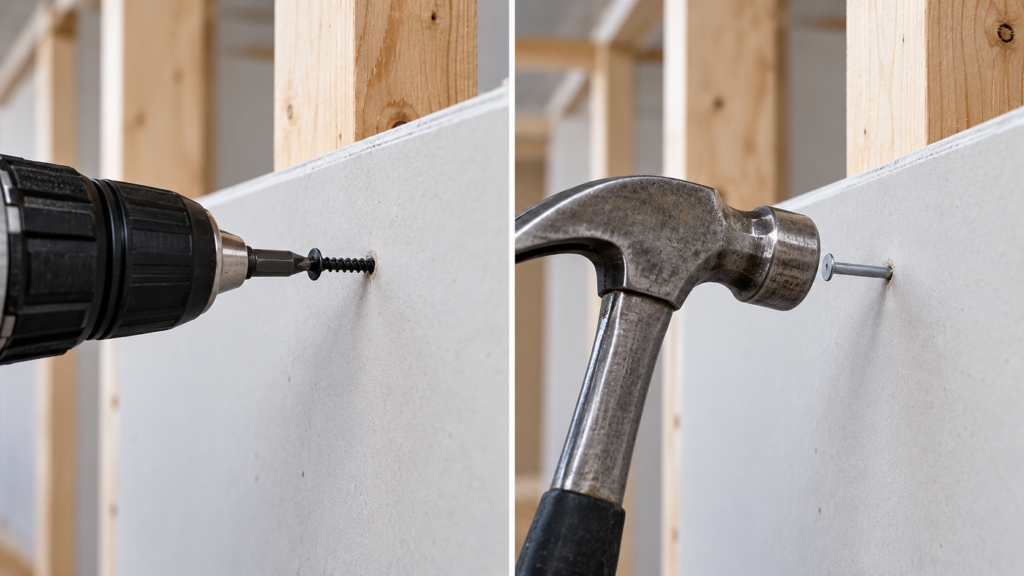
Drywall Screws vs Nails: Which Is Better for Drywall Installation?
When installing gypsum board, one common question is whether to use drywall screws or drywall nails.
Quick answer: For many modern drywall installations, screws are commonly preferred because their threaded design provides good engagement with the framing and they are easy to control with a screwgun. Drywall nails can still be suitable where the board system and project specification allow nail fastening.
The right choice depends on the framing material, wall or ceiling application, installation method and project requirements.
What Are Drywall Screws?
Drywall screws are threaded fasteners designed for attaching gypsum board to framing.
Different screw types may be used depending on the framing material.
Common examples include:
- Coarse-thread drywall screws for timber framing
- Fine-thread drywall screws for light-gauge metal framing
Drywall screws normally use a bugle-style head that allows the fastener to sit slightly below the board surface.
The screw should be driven carefully so that the head forms a small recess without damaging the face paper.
What Are Drywall Nails?
Drywall nails are fasteners designed specifically for attaching gypsum board, particularly to timber framing.
They are different from ordinary finishing nails.
The nail head provides a surface for securing the board against the framing, while the shaft penetrates into the timber.
Like screws, drywall nails should be installed carefully. Driving them too deeply can damage the board surface.
Drywall Screws vs Nails: Quick Comparison
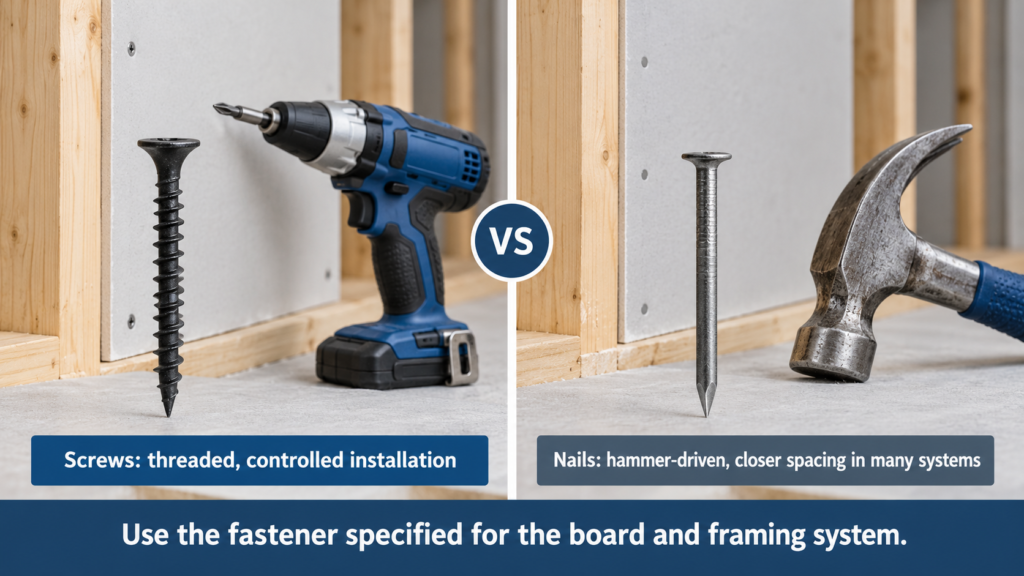
| Factor | Drywall Screws | Drywall Nails |
|---|---|---|
| Installation | Screwgun or drill | Hammer or suitable nailer |
| Shaft | Threaded | Nail shaft |
| Depth control | Easier with a drywall screwgun | Depends more on installation technique |
| Wood framing | Commonly used | Can be used where permitted |
| Metal framing | Suitable screw types available | Generally not the usual choice |
| Removal | Easier to remove individually | Usually harder to remove cleanly |
| Fastener spacing | Often wider in common systems | Often requires closer spacing |
| Fastener pops | Possible if improperly installed | Movement may contribute to nail pops |
The correct fastener and spacing should always follow the requirements of the specific gypsum board system.
Which Has Better Holding Power?
Drywall screws use threads to engage with the framing material.
This threaded engagement is one reason screws are widely used for gypsum board installation.
Drywall nails rely on penetration and friction within the framing.
Both can provide suitable attachment when the correct fastener and installation method are used.
However, screws and nails may require different spacing, so they should not be substituted without checking the project requirements.
Why Are Screws Often Spaced Farther Apart?
In many drywall systems, screws can be installed at wider spacing than nails.
The exact fastener spacing depends on factors such as:
- Wall or ceiling application
- Framing type
- Fastener type
- Number of gypsum board layers
- Board orientation
- Use of adhesive
- Tested assembly requirements
This is why one spacing value should not be applied to every drywall installation.
Installation Speed: Screws vs Nails
Both methods can be fast when the installer uses the correct tools.
Drywall nails can be installed quickly with a hammer or suitable fastening tool.
Drywall screws are normally installed using a drill or drywall screwgun.
A screwgun with depth control can help installers set screw heads consistently without overdriving them.
For larger projects, installation speed will depend on:
- Installer experience
- Tools available
- Framing material
- Required fastener spacing
- Project size
Which Gives Better Installation Control?
Screws generally provide good depth control when installed with a proper drywall screwgun.
The screw head can be set slightly below the board surface while leaving the face paper intact.
With nails, the installer needs to control the driving force manually or through the fastening tool.
Both screws and nails can cause problems if driven too deeply.
The goal is to secure the board without breaking the paper surface.
What Are Nail Pops?
A nail pop is a visible bump or small crack that appears around a drywall fastener after finishing.
It may occur because of:
- Timber movement
- Fastener movement
- Improper installation
- Framing changes
- Fasteners not seated correctly
Although the term “nail pop” is common, screws can also become visible if the installation or framing moves.
Correct installation is important regardless of the fastener type.
Screws vs Nails for Drywall Walls
Both screws and approved drywall nails may be used for wall applications where the gypsum board system permits them.
Screws are widely used because they:
- Engage with the framing through threads
- Can be installed with controlled depth
- Work with suitable wood and steel framing
- May allow wider spacing in some systems
Nails remain an option in appropriate timber-framed systems.
Screws vs Nails for Drywall Ceilings
Ceiling drywall is installed overhead, so correct fastening is particularly important.
Screws are commonly used for ceiling applications because their threaded design provides positive engagement with the framing.
Ceilings may also require closer fastener spacing than walls.
Drywall nails can still be used in ceiling systems that specifically permit nail fastening, but the applicable fastening pattern must be followed. For more detail on wall and ceiling fastening distances, see our drywall screw spacing guide.
Drywall Screws for Wood Framing
Coarse-thread drywall screws are commonly used with timber framing.
The wider thread pattern helps the screw engage with the wood.
When selecting the screw, consider:
- Gypsum board thickness
- Number of layers
- Required penetration
- Framing dimensions
- Project specification
The screw should provide adequate engagement with the framing.
Drywall Screws for Metal Framing
For light-gauge metal framing, fine-thread drywall screws are commonly used.
The finer thread pattern is better suited to this type of framing than a typical coarse-thread wood-framing screw.
Metal thickness is also important.
Different steel thicknesses may require different screw designs, so the fastener should be matched to the actual framing system.
Can Drywall Nails Be Used With Metal Studs?
Drywall nails are mainly associated with timber framing.
For steel studs, appropriately selected drywall screws are normally used.
This is an important difference between screws and nails: drywall screw types are available specifically for fixing gypsum board to suitable metal framing.
What About Fastener Pops?
Fastener pops are not caused by the fastener type alone.
Possible causes include:
- Framing movement
- Improper installation depth
- Missing the framing member
- Board movement
- Incorrect fastener selection
Using screws does not guarantee that fastener pops will never occur.
Correct installation and suitable framing conditions are still important.
Cost: Drywall Screws vs Nails
The fastener price alone does not determine the total installation cost.
Other factors include:
- Number of fasteners required
- Installation time
- Labour cost
- Tools
- Rework
- Framing material
- Project specification
A cheaper individual fastener does not automatically mean a cheaper completed installation.
When Drywall Nails May Be Suitable
Drywall nails may be suitable when:
- The installation uses timber framing
- The gypsum board system permits nail fastening
- The correct drywall nail is used
- Required spacing is followed
- The project specification allows nails
Ordinary finishing nails should not be treated as a substitute for purpose-made drywall nails.
When Drywall Screws Are Commonly Preferred
Drywall screws are commonly preferred when:
- Working with metal studs
- A screwgun is available
- Controlled driving depth is important
- The system specifies screw attachment
- Suitable screw spacing is preferred
- Individual fasteners may need to be removed later
For many modern drywall installations, this makes screws a practical option.
Common Mistakes When Using Drywall Screws
Overdriving the Screw
Driving the head too deep can tear the face paper and reduce the quality of the fixing.
Using the Wrong Thread Type
Timber and metal framing may require different drywall screw types.
Incorrect Spacing
Do not assume the same spacing applies to every wall, ceiling or assembly.
Missing the Framing
The screw needs to engage with the framing member behind the board.
Choosing the Wrong Length
The screw should provide suitable penetration for the board and framing system.
Common Mistakes When Using Drywall Nails
Using Ordinary Nails
Use fasteners intended for gypsum board installation rather than general finishing nails.
Driving the Nail Too Deep
The nail should create a slight recess without tearing the board surface.
Driving at an Incorrect Angle
Fasteners should be installed correctly into the framing rather than driven at an uncontrolled angle.
Incorrect Fastener Spacing
Nail spacing may differ from screw spacing, so the applicable system requirements should be followed.
What About Fire-Rated Drywall Systems?
Fire-rated walls and ceilings require extra care.
The fastener type, size, spacing and number of gypsum board layers may all form part of the tested assembly.
Do not replace nails with screws, or screws with nails, in a fire-rated assembly without confirming that the change is permitted.
Always follow the tested system and project specification.
Drywall Screws vs Nails: Which Should You Choose?
or many modern drywall projects, drywall screws are usually the more practical choice because they provide threaded engagement, good depth control and options for both timber and suitable metal framing.
However, this does not mean drywall nails are always incorrect.
Drywall nails can still be appropriate where:
- The system permits them
- Timber framing is used
- The correct nail type is selected
- Required spacing and installation practices are followed
The best fastener is the one that matches the actual gypsum board system and framing material.
Quick Decision Guide
Consider drywall screws when:
- Installing drywall on metal studs
- Using a drywall screwgun
- Controlled installation depth is important
- The system specifies screw fastening
- Suitable screws are available for the framing
Drywall nails may be suitable when:
- Working with timber framing
- The system allows nail fastening
- Purpose-made drywall nails are being used
- The required fastening pattern is followed
Frequently Asked Questions
Are drywall screws better than nails?
For many modern installations, screws are commonly preferred because they provide threaded engagement and good installation control. Nails can still be suitable where the drywall system permits them.
Can you use nails for drywall?
Yes. Purpose-made drywall nails can be used in suitable gypsum board systems, particularly with timber framing.
Can regular nails be used instead of drywall nails?
It is better to use fasteners specifically intended for gypsum board installation rather than ordinary finishing nails.
Which is better for metal studs?
Appropriately selected drywall screws are normally used for light-gauge steel framing.
Do screws require fewer fastening points than nails?
In many common systems, screws may be permitted at wider spacing than nails. The exact spacing depends on the specific board and assembly.
Can screws prevent nail pops completely?
No. Fastener visibility can still occur because of installation errors, framing movement or other project conditions.
Can nails be replaced with screws in a fire-rated wall?
Do not make that substitution without checking the tested assembly requirements..
Final Thoughts
Drywall screws and drywall nails can both be valid gypsum board fasteners when used in the correct system.
For many current drywall projects, screws are commonly preferred because they offer threaded engagement, controlled installation and suitable options for both timber and metal framing.
Drywall nails remain useful in systems designed for nail fastening, especially with timber framing.
Before installation, confirm the framing material, board type, fastener requirements and applicable project specification.
For suitable drywall screw options, explore the ScrewBee drywall screw range or contact the team with your project requirements.