
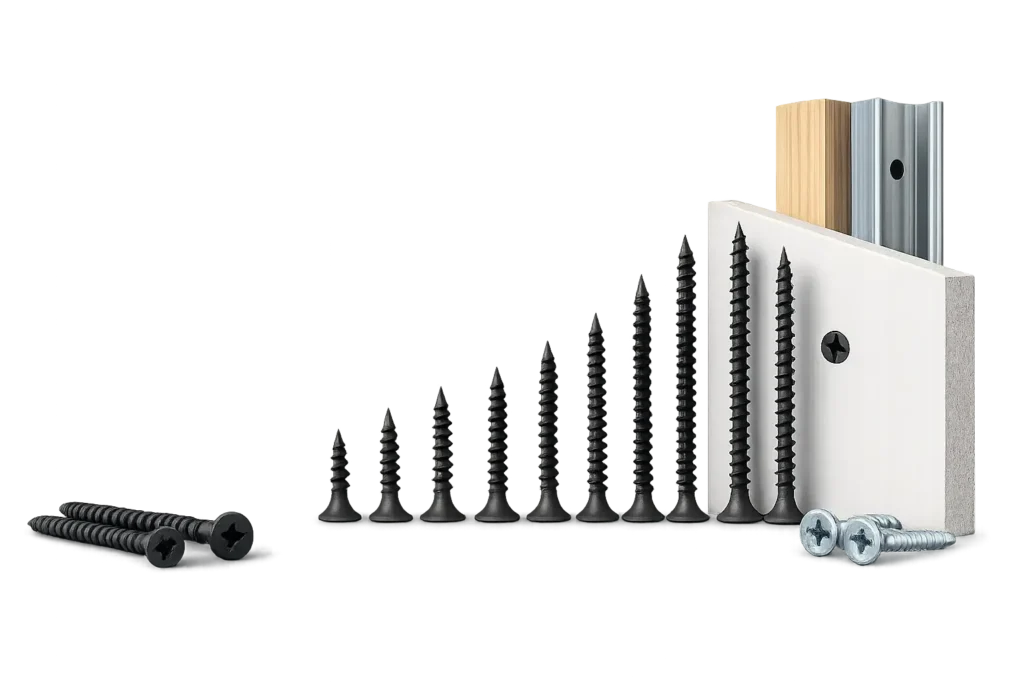
Sheetrock Screws vs Drywall Screws: Sizes, Types and Uses
People searching for sheetrock screws often wonder whether they are different from drywall screws. In everyday construction use, both terms generally refer to fasteners designed to attach gypsum board panels to wood or suitable metal framing.
“Sheetrock” is a commonly used name for gypsum board, while “drywall” is the broader construction term. Although the names are often used interchangeably, the actual screw specification can vary by thread type, diameter, length, finish and intended application.
This guide explains what sheetrock screws are, how they compare with drywall screws, the available sizes, common applications and the important factors to consider when selecting a suitable screw.
What Are Sheetrock Screws?
Are Sheetrock Screws and Drywall Screws the Same?
A sheetrock screw is a purpose-designed fastener used to attach gypsum board or drywall panels to a supporting frame.
These screws are widely used in:
- Interior wall systems
- Drywall partitions
- False ceilings
- Plasterboard installations
- Residential renovation projects
- Commercial interior fit-outs
- Wood and metal framing systems
Sheetrock screws are designed to penetrate the board and grip the supporting frame while allowing the screw head to sit neatly below the board surface.
In most buying and installation contexts, sheetrock screws and drywall screws refer to the same general category of gypsum-board fastener.
The difference is mainly in the terminology:
- Drywall screws is the broader industry term.
- Sheetrock screws is a commonly used alternative term.
- Gypsum board screws is another name used in some markets.
- Plasterboard screws is also used in certain regions.
However, the product name alone does not determine whether a screw is suitable for a particular project.
Before choosing a screw, buyers should confirm:
- Thread type
- Nominal diameter
- Screw length
- Head style
- Drive type
- Finish
- Supporting material
- Installation environment
Two products may both be called sheetrock screws but still have different applications.
Main Features of Sheetrock Screws
Typical sheetrock screw features include:
- Phillips bugle head
- Sharp driving point
- Fine or coarse thread
- Hardened steel construction
- Black or zinc finish
- No. 2 Phillips drive
Phillips Bugle Head
The bugle-shaped head has a curved underside that helps distribute pressure around the fixing point.
When installed correctly, the head sits slightly below the board surface without excessively damaging the outer paper facing. This makes it easier to apply joint compound and achieve a smooth finish.
Sharp Point
The sharp point helps the screw begin penetrating the board and supporting material quickly.
In many standard drywall installations, this reduces or removes the need for pre-drilling. Suitability still depends on the framing material and its thickness.
Phillips Drive
A Phillips drive allows the screw to be installed using a commonly available screwdriver bit or power driver.
Using the correct bit size helps reduce slipping, damage to the screw head and inconsistent installation depth.
Fine Thread vs Coarse Thread Sheetrock Screws
Thread type is one of the most important factors when selecting screws for gypsum board installation.
The correct choice depends mainly on whether the supporting frame is made from wood or suitable light-gauge metal.
Coarse-Thread Sheetrock Screws
Coarse-thread screws have deeper threads with wider spacing between them.
They are commonly selected for:
- Wood studs
- Timber framing
- Wooden battens
- Plywood backing
- Wood-based partition systems
The deeper thread profile helps grip wood fibres effectively and provides a secure hold in suitable wooden materials.
Coarse-thread screws are generally easier to drive into wood because the wider thread spacing allows them to advance quickly.
Fine-Thread Sheetrock Screws
Fine-thread screws have more closely spaced threads.
They are commonly selected for:
- Suitable light-gauge metal studs
- Metal tracks
- Interior steel framing
- Metal partition systems
- Certain ceiling framing systems
The finer thread pattern helps engage suitable thin metal sections more effectively.
Metal framing thickness is important. A screw should always be matched to the framing gauge and the project specification.
Fine Thread and Coarse Thread Comparison
| Feature | Coarse Thread | Fine Thread |
|---|---|---|
| Common framing material | Wood | Suitable light-gauge metal |
| Thread spacing | Wide | Close |
| Thread depth | Deeper | Shallower and more frequent |
| Common applications | Timber studs and battens | Metal studs and tracks |
| Driving behaviour | Advances quickly in wood | Engages thin metal more gradually |
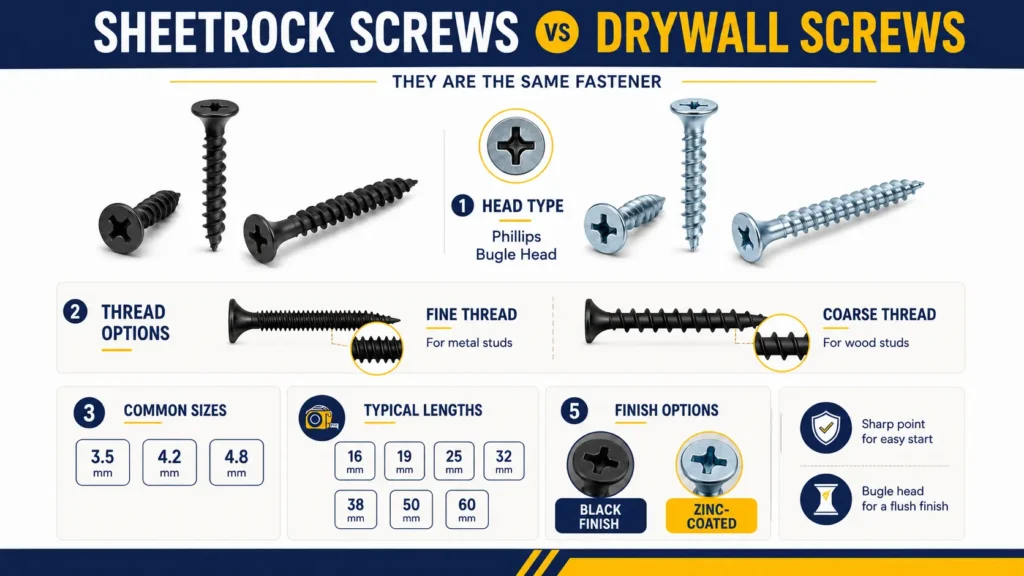
Available Sheetrock Screw Sizes
Sheetrock screws are available in several nominal diameters and lengths.
The ScrewBee range includes 3.5 mm, 4.2 mm and 4.8 mm nominal diameters, with lengths from 16 mm to 60 mm depending on the diameter.
| Nominal Diameter | Available Lengths in Millimetres | Approximate Inch Sizes |
|---|---|---|
| 3.5 mm | 16, 19, 25, 32, 38, 50 | 5/8, 3/4, 1, 1-1/4, 1-1/2, 2 |
| 4.2 mm | 19, 25, 32, 38, 50, 60 | 3/4, 1, 1-1/4, 1-1/2, 2, 2-3/8 |
| 4.8 mm | 50, 60 | 2, 2-3/8 |
The range includes:
- Black finish
- Zinc finish
- Fine-thread options
- Coarse-thread options
- Phillips bugle head
- No. 2 Phillips drive
The right size depends on the board thickness, number of board layers, supporting frame and installation requirements.
How Long Should a Sheetrock Screw Be?
A sheetrock screw must be long enough to pass through the gypsum board and achieve adequate engagement with the supporting frame.
The required length depends on:
- Board thickness
- Single-layer or multi-layer installation
- Wood or metal framing
- Wall or ceiling application
- Required framing penetration
- Project specification
A standard single-layer wall installation normally requires a shorter screw than a multi-layer partition or ceiling system.
The screw should not be selected only according to board thickness. The depth required inside the supporting frame must also be considered.
Risks of Using a Screw That Is Too Short
A screw that is too short may:
- Fail to engage the frame adequately
- Provide poor holding strength
- Allow the board to move
- Cause loose panels
- Create cracks in the finished joint
Risks of Using a Screw That Is Too Long
An unnecessarily long screw may:
- Take longer to install
- Be unsuitable for the framing system
- Contact concealed services
- Increase material cost
- Provide no additional fixing benefit
Always confirm the required length before beginning installation.
Common Applications of Sheetrock Screws
Sheetrock screws are mainly used for attaching gypsum board and similar interior panels to supporting frames.
Common applications include:
- Gypsum board wall installation
- Drywall partition systems
- False ceiling installation
- Plasterboard fixing
- Interior lining systems
- Residential renovation
- Office fit-out work
- Retail interior construction
- Wood stud framing
- Light-gauge metal stud framing
These screws are intended mainly for board-fixing applications.
They should not automatically be used as substitutes for structural fasteners, roofing screws, masonry screws or exterior-grade fasteners.
Black Sheetrock Screws
Black sheetrock screws are commonly used for dry indoor gypsum-board applications.
Typical uses include:
- Interior drywall walls
- False ceilings
- Partition systems
- Wooden support frames
- Residential interiors
- Commercial fit-out projects
The dark finish is commonly associated with traditional drywall screw products.
Standard black-finished screws may not be suitable for areas exposed to persistent moisture, exterior weather or highly corrosive conditions unless the product is specifically rated for those environments.
Zinc Sheetrock Screws
Zinc-finished sheetrock screws provide additional surface protection compared with plain, uncoated steel.
Potential benefits include:
- Better resistance to surface corrosion
- Improved protection during storage
- Suitability for certain humid indoor conditions
- Clean metallic appearance
- More consistent surface protection
The level of corrosion resistance depends on:
- Coating thickness
- Coating process
- Product quality
- Surface preparation
- Testing method
- Installation environment
ScrewBee states that its drywall screws undergo salt spray testing for up to 124 hours and are manufactured using Taiwan technology in accordance with ISO 9001:2015 standards.
Zinc finishing alone does not automatically make a screw suitable for exterior or highly corrosive environments. The product specification should always be checked before use.
The right finish depends on the installation environment and project requirements rather than appearance alone.
Sheetrock Screws for Wood Studs
Coarse-thread screws are generally preferred for typical wood framing.
They are commonly used with:
- Timber studs
- Wooden battens
- Plywood
- Wood-based backing
- Interior wooden partitions
When choosing a screw for wood framing, check:
- Board thickness
- Screw diameter
- Screw length
- Thread profile
- Required penetration
- Head seating
- Installation spacing
The deeper threads of a coarse-thread screw help grip wood fibres securely.
The screw head should sit slightly below the board surface without tearing through the paper facing.
Sheetrock Screws for Metal Studs
Fine-thread screws are commonly selected for suitable light-gauge metal framing.
They may be used with:
- Metal studs
- Steel tracks
- Interior framing sections
- Metal ceiling systems
- Light-gauge partition frameworks
Metal thickness matters. Some framing systems require a specific screw point, thread design or approved fastener type.
A standard fine-thread drywall screw should not automatically be assumed suitable for every thickness of metal.
Always match the screw specification to the framing system.
Wall vs Ceiling Applications
Sheetrock screws are used in both wall and ceiling systems, but ceiling installations may place greater demand on the fasteners.
Wall Installations
For wall applications, consider:
- Board thickness
- Stud material
- Screw spacing
- Board orientation
- Edge distance
- Number of board layers
Ceiling Installations
For ceiling applications, consider:
- Board weight
- Framing spacing
- Screw length
- Screw spacing
- Number of board layers
- Approved system requirements
Ceiling boards must be securely supported because gravity continuously acts on the panels.
The complete ceiling system should follow the board and framing manufacturer’s recommendations.
How to Choose the Right Sheetrock Screw
Choosing the right screw involves more than selecting a familiar length.
Follow these steps before purchasing or installing sheetrock screws.
1. Identify the Framing Material
Determine whether the board will be attached to:
- Wood studs
- Metal studs
- Wooden battens
- Plywood
- Another approved substrate
This decision helps determine the appropriate thread type.
2. Select the Correct Thread
As a general guide:
- Choose coarse thread for typical wood framing.
- Choose fine thread for suitable light-gauge metal framing.
Always confirm product compatibility with the supporting material.
3. Check the Board Thickness
Consider whether the project uses:
- Standard gypsum board
- Thicker board
- Multiple board layers
- Ceiling board
- Fire-rated board
- Moisture-resistant board
- Special lining systems
Thicker or multi-layer boards usually require longer screws.
4. Choose the Correct Diameter
The diameter affects the screw body, head dimensions and general fastening performance.
Select a diameter that matches the available product specification and installation requirement.
5. Select the Correct Length
The screw must pass through the board and achieve adequate engagement with the supporting frame.
Avoid selecting a screw that is too short or unnecessarily long.
6. Choose the Finish
Select the finish according to:
- Indoor humidity
- Storage conditions
- Corrosion requirements
- Appearance requirements
- Project specifications
- Expected service environment
7. Confirm the Head and Drive
Check that the screw includes the required:
- Bugle head
- Phillips drive
- Driver-bit size
Using the correct bit improves control and reduces screw-head damage.
8. Verify Product Documentation
Before placing a bulk order, confirm:
- Diameter
- Length
- Thread type
- Head style
- Drive type
- Finish
- Packing quantity
- Product testing
- Intended application
- Manufacturing consistency
Common Sheetrock Screw Installation Mistakes
Incorrect screw selection or installation can reduce fastening performance and damage the board.
Using the Wrong Thread Type
Using coarse-thread screws in unsuitable thin metal may result in poor engagement or stripped fixing points.
Using fine-thread screws in wood may provide less grip than a suitable coarse-thread product.
Driving the Screw Too Deep
Overdriving can tear the paper facing and weaken the fixing point.
Once the paper is broken, the screw may no longer hold the board correctly.
Leaving the Screw Head Raised
A raised screw head may interfere with:
- Joint compound
- Surface sanding
- Painting
- Final finishing
The head should sit slightly below the board surface without breaking through the paper.
Choosing the Wrong Length
A short screw may not engage the supporting frame adequately.
An unnecessarily long screw may contact concealed wiring, pipes or other services.
Installing Too Close to the Board Edge
Placing a screw too close to the edge can:
- Crack the gypsum core
- Tear the paper facing
- Break the board corner
- Reduce fixing strength
Follow the recommended edge distance for the board system.
Using Excessive Driving Speed
Excessive speed can cause:
- Overdriving
- Damaged screw heads
- Torn board paper
- Poor depth control
- Inconsistent installation
Use controlled speed and appropriate driver settings.
Using a Damaged Driver Bit
A worn or incorrect driver bit may slip out of the screw head and damage the drive recess.
Replace damaged bits and use the correct No. 2 Phillips bit where specified.
Using Sheetrock Screws for Structural Work
Sheetrock screws are mainly designed for fixing gypsum board panels.
They should not automatically replace structural wood screws, bolts, anchors or other load-rated fasteners.
Installation Tips
For a clean and reliable installation:
- Hold the screw perpendicular to the board.
- Use the correct driver bit.
- Use a No. 2 Phillips bit where specified.
- Start the screw with controlled pressure.
- Avoid excessive driving speed.
- Seat the bugle head slightly below the surface.
- Do not tear through the paper facing.
- Follow the recommended screw spacing.
- Maintain the specified distance from panel edges.
- Check framing alignment before installation.
- Confirm the required screw length.
- Match the thread type to the substrate.
- Replace damaged or stripped screws.
- Follow the approved board-system specification.
Buying Sheetrock Screws in Bulk
Bulk buyers should evaluate more than the basic screw size.
Important factors include:
- Product diameter
- Available lengths
- Fine- and coarse-thread options
- Black and zinc finishes
- Head dimensions
- Drive type
- Coating consistency
- Corrosion testing
- Packing quantity
- Batch consistency
- Supply capacity
- Quality documentation
Contractors, dealers and distributors should request complete product details before placing large orders.
A clear specification helps prevent incorrect supply and installation delays.
Frequently Asked Questions
Are Sheetrock Screws and Drywall Screws Interchangeable?
The terms commonly refer to the same general category of gypsum-board fastener.
However, the exact screw specification must still match the framing material, board thickness and installation requirements.
Why Are They Called Sheetrock Screws?
Sheetrock is a widely recognised name associated with gypsum board. As a result, many people use the term sheetrock screws when referring to screws used for drywall installation.
Can Sheetrock Screws Be Used on Wood Studs?
Yes. Coarse-thread screws are commonly selected for wood studs, timber framing and wooden battens.
Can Sheetrock Screws Be Used on Metal Studs?
Yes, when the screw is suitable for the type and thickness of the metal framing.
Fine-thread screws are commonly selected for suitable light-gauge metal systems.
Do Sheetrock Screws Require Pre-Drilling?
In many standard drywall installations, pre-drilling is not required.
Harder materials, thicker metal or specialised framing systems may require a different screw type or installation method.
What Sheetrock Screw Sizes Are Available?
Common ScrewBee nominal diameters include:
- 3.5 mm
- 4.2 mm
- 4.8 mm
Available lengths range from 16 mm to 60 mm depending on the selected diameter.
Conclusion
Sheetrock screws and drywall screws generally refer to the same category of fastener used for attaching gypsum board panels to supporting frames.
The correct screw should be selected according to:
- Framing material
- Fine or coarse thread
- Nominal diameter
- Screw length
- Board thickness
- Black or zinc finish
- Installation environment
- Project specification
Coarse-thread screws are commonly used for wood framing, while fine-thread screws are generally selected for suitable light-gauge metal framing.
ScrewBee offers black and zinc sheetrock screws with fine- and coarse-thread options, Phillips bugle heads and No. 2 Phillips drives. Available nominal diameters include 3.5 mm, 4.2 mm and 4.8 mm, with lengths ranging from 16 mm to 60 mm depending on the diameter.
Before purchasing or installing screws, always verify the complete product specification and confirm that it matches the board, framing system and intended environment.